
Contents
Understanding Business Processes and Information Systems
In the realm of business, the terms “business processes” and “information systems” are often thrown around, but what do they really mean? A business process is a series of tasks or activities that organizations undertake to achieve a specific goal. These processes can range from simple tasks, like managing a customer inquiry, to complex operations, such as supply chain management. The purpose of business processes is to create efficiency, improve productivity, and enhance customer satisfaction. On the other hand, information systems are structured systems designed to collect, store, manage, and distribute information. They are essential for supporting business processes by providing the necessary data and tools to make informed decisions.
The relevance of business processes and information systems extends across organizations of all sizes, from small businesses to large enterprises. For small businesses, efficient processes can mean the difference between success and failure. They often operate with limited resources, making it crucial to streamline operations and maximize output. Information systems can help small business owners automate tasks, manage customer relationships, and track inventory, ultimately leading to better decision-making and improved profitability.
In larger organizations, the complexity of operations necessitates robust business processes and sophisticated information systems. These companies often deal with vast amounts of data and require systems that can handle this information efficiently. Industries such as manufacturing, healthcare, retail, and finance rely heavily on these concepts. For instance, in manufacturing, information systems are used to monitor production processes, manage supply chains, and ensure quality control. In healthcare, they facilitate patient record management and streamline billing processes.
The Intersection of Business Processes and Information Systems
The relationship between business processes and information systems is symbiotic. Business processes define the workflows that organizations follow, while information systems provide the backbone that supports these workflows. When implemented effectively, information systems can enhance business processes by automating repetitive tasks, reducing errors, and providing real-time data for decision-making.
For example, consider a small auto repair shop. The business process might involve receiving a customer vehicle, diagnosing the issue, providing a quote, and completing the repair. An information system can streamline this process by tracking customer information, managing appointments, and even automating follow-up communications. This integration not only saves time but also enhances the customer experience, as clients receive timely updates and accurate information about their vehicle repairs.
Applicability Across Industries
The applicability of business processes and information systems is vast, touching various industries in unique ways. In the automotive sector, for instance, dealerships and service centers utilize information systems to manage inventory, track sales, and maintain customer relationships. This ensures that they can respond quickly to customer needs and maintain a competitive edge.
In the retail industry, point-of-sale systems are a prime example of how information systems support business processes. These systems not only facilitate transactions but also collect data on customer preferences and inventory levels, allowing retailers to optimize their operations.
In conclusion, understanding the relationship between business processes and information systems is critical for organizations aiming to improve efficiency and effectiveness. Whether you are a small auto repair shop or a large manufacturing firm, leveraging these concepts can lead to significant improvements in operational performance and customer satisfaction.

How Business Processes and Information Systems Work Together
Business processes and information systems are interlinked components that play a crucial role in the operational framework of organizations. Their integration is fundamental for enhancing efficiency, improving decision-making, and maintaining competitiveness in various industries.
Components of Business Processes and Information Systems
To grasp how these systems work together, it’s essential to identify their key components:
- Business Processes: These include the steps or activities that organizations undertake to produce a product or service. They can be categorized into core processes (directly related to product/service delivery) and support processes (such as HR and finance).
- Information Systems: These consist of hardware, software, data, procedures, and people that work together to collect, process, store, and disseminate information. Key types include transaction processing systems, management information systems, and decision support systems.
- Data: The information collected and processed by the information systems, which is crucial for making informed decisions.
- Users: The individuals who interact with the information systems, including employees, managers, and customers.
Role in Supporting Business Operations
The integration of business processes and information systems serves several vital functions:
1. Automation of Tasks: Information systems can automate routine tasks within business processes, reducing the time and effort required to complete them. For example, an auto repair shop can use a system to automatically schedule appointments and send reminders to customers.
2. Data Management: Information systems facilitate the efficient management of data, ensuring that relevant information is readily available for decision-making. This is particularly important in industries where timely and accurate data can influence operational success.
3. Real-Time Monitoring: Information systems allow organizations to monitor business processes in real time, enabling quick responses to any issues that may arise. For instance, a manufacturing plant can track production metrics and quickly identify bottlenecks.
4. Enhanced Communication: These systems improve communication within and between departments, ensuring that everyone is on the same page. This is especially critical in larger organizations where multiple teams must collaborate to achieve common goals.
Advantages of Integrating Business Processes and Information Systems
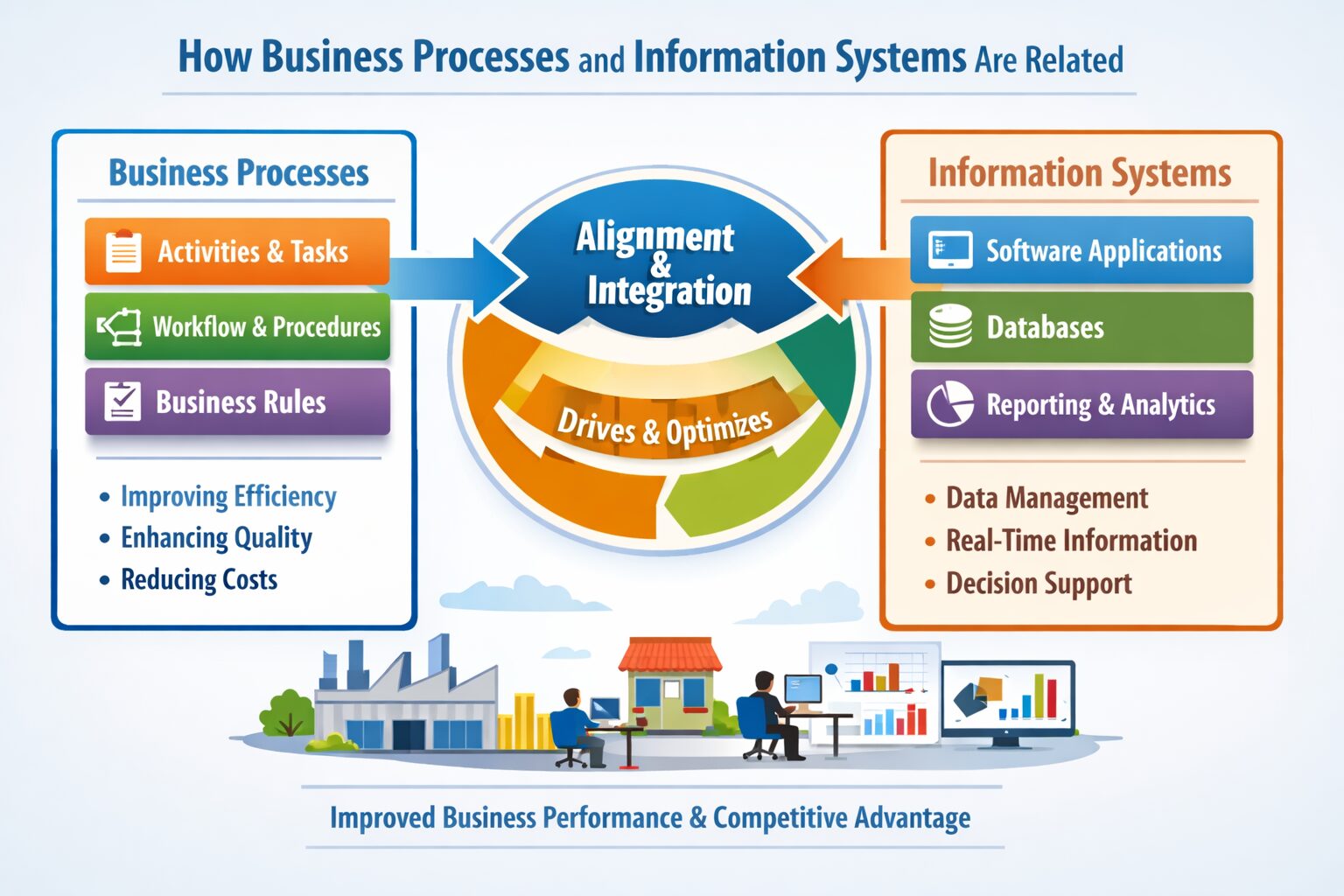
The integration of business processes and information systems offers several advantages:
- Increased Efficiency: By automating tasks and streamlining workflows, organizations can operate more efficiently, allowing them to serve more customers or produce more products without increasing costs.
- Improved Decision-Making: Access to real-time data enables managers to make informed decisions quickly, which can lead to better outcomes and increased agility in responding to market changes.
- Cost Savings: Streamlined processes can lead to significant cost reductions, as organizations can minimize waste and optimize resource allocation.
- Enhanced Customer Satisfaction: Faster response times and improved service quality contribute to higher levels of customer satisfaction, which is crucial for retaining clients and attracting new ones.
Potential Drawbacks
Despite the numerous advantages, there are potential drawbacks to consider:
- Implementation Costs: The initial investment in information systems can be substantial, particularly for small businesses. This includes software, hardware, and training costs.
- Complexity: Integrating new systems into existing processes can be complex and may require significant changes to workflows, which can disrupt operations temporarily.
- Dependence on Technology: Over-reliance on information systems can lead to vulnerabilities, particularly if systems fail or are compromised. Organizations must have contingency plans in place.
Real-World Applications and Influence
The influence of business processes and information systems on efficiency, decision-making, and competitiveness is evident across various industries:
– Automotive Industry: Dealerships utilize customer relationship management (CRM) systems to track customer interactions, manage leads, and streamline sales processes. This leads to improved customer engagement and increased sales.
– Healthcare Sector: Hospitals employ electronic health record (EHR) systems to manage patient information, facilitating better coordination among healthcare providers. This results in improved patient outcomes and more efficient operations.
– Retail: Retailers use inventory management systems to monitor stock levels and automate reordering processes. This ensures that popular items are always in stock, enhancing customer satisfaction and driving sales.
– Manufacturing: Companies implement enterprise resource planning (ERP) systems to integrate various functions, including supply chain management, production planning, and financial management. This holistic approach improves overall efficiency and reduces operational costs.
In summary, the relationship between business processes and information systems is vital for organizations aiming to thrive in today’s competitive landscape. By understanding and leveraging this relationship, businesses can enhance their operations, make informed decisions, and ultimately achieve greater success.
Guidance on Assessing Business Processes and Information Systems
When organizations consider integrating or improving their business processes and information systems, a thorough assessment is crucial. This evaluation helps ensure that the chosen system aligns with the organization’s goals and operational needs. Below are key evaluation criteria and steps for implementation, integration, or improvement.
Evaluation Criteria
To effectively assess a business process or information system, consider the following criteria:
| Criteria | Description |
|---|---|
| Cost | Evaluate both initial and ongoing costs, including software, hardware, training, and maintenance expenses. |
| Scalability | Determine if the system can grow with the business. Can it handle increased data volume and user load without significant performance issues? |
| Compatibility | Assess how well the system integrates with existing tools and processes. Will it work seamlessly with current software and hardware? |
| Security | Evaluate the security measures in place to protect sensitive data. What protocols are used to ensure data integrity and confidentiality? |
| User Adoption | Consider how easy the system is to use. Will employees require extensive training, or can they adapt quickly? |
Steps for Implementation
Implementing or integrating a new business process or information system involves several key steps:
- Define Objectives: Clearly outline what you aim to achieve with the new system. This could include improving efficiency, reducing costs, or enhancing customer satisfaction.
- Conduct a Needs Assessment: Gather input from stakeholders across the organization to understand their needs and expectations. This will help tailor the system to suit various departments.
- Research Solutions: Explore different software and systems that meet your evaluation criteria. Consider demos, trials, or case studies to assess their effectiveness.
- Budgeting: Create a detailed budget that accounts for all costs associated with the implementation, including training and potential downtime.
- Develop an Implementation Plan: Outline a timeline for the implementation process, including milestones and responsibilities. Ensure that this plan is communicated to all stakeholders.
- Training and Support: Provide adequate training for users to ensure they are comfortable with the new system. Ongoing support should also be available to address any issues that arise.
- Monitor and Evaluate: After implementation, continuously monitor the system’s performance against the defined objectives. Make adjustments as necessary to optimize its effectiveness.
Challenges Businesses Might Face

While implementing or improving business processes and information systems can yield significant benefits, organizations may encounter several challenges:
- Resistance to Change: Employees may be hesitant to adopt new systems, fearing that it will disrupt their workflows or require them to learn new skills.
- Data Migration Issues: Transferring data from old systems to new ones can be complex and may result in data loss or corruption if not managed carefully.
- Integration Difficulties: Ensuring that the new system works well with existing tools and processes can be challenging, especially in organizations with legacy systems.
- Budget Overruns: Unexpected costs can arise during implementation, leading to budget overruns that can strain resources.
- Security Concerns: New systems can introduce vulnerabilities if not properly secured. Organizations must prioritize data protection to mitigate risks.
Conclusion
By carefully assessing business processes and information systems using the outlined criteria and following the implementation steps, organizations can effectively enhance their operations. While challenges may arise, a proactive approach to evaluation and integration can lead to significant improvements in efficiency, decision-making, and overall competitiveness.
Summary of Key Points
The relationship between business processes and information systems is critical for organizations aiming to enhance efficiency and competitiveness. This integration not only streamlines operations but also provides valuable data for decision-making. The following points summarize the main aspects of this relationship:
Definition and Relevance
– Business processes are structured activities designed to achieve specific organizational goals, while information systems are the tools that support these processes by managing data and facilitating communication.
– Both concepts are relevant across various industries, including automotive, healthcare, retail, and manufacturing, where they help organizations operate more effectively.
Assessment and Evaluation Criteria
To effectively assess business processes and information systems, organizations should consider:
– Cost: Evaluate both initial and ongoing expenses.
– Scalability: Determine if the system can grow with the organization.
– Compatibility: Assess how well the system integrates with existing tools.
– Security: Evaluate the measures in place to protect sensitive data.
– User Adoption: Consider the ease of use and training requirements.
Implementation Steps and Challenges
The implementation process involves several steps:
- Define objectives.
- Conduct a needs assessment.
- Research solutions.
- Budgeting.
- Develop an implementation plan.
- Training and support.
- Monitor and evaluate.
Challenges may include resistance to change, data migration issues, integration difficulties, budget overruns, and security concerns.
Importance of Integration
Integrating business processes with information systems is essential for achieving operational efficiency and informed decision-making. The synergy between these elements allows organizations to respond quickly to market changes and customer needs.
Supporting Statistics
– According to a study by McKinsey, companies that effectively integrate digital technologies into their business processes can increase productivity by up to 20-25%.
– A report from the Harvard Business Review indicates that organizations that leverage data-driven decision-making are 5-6% more productive than their competitors.
Case Studies and Real-World Applications
– Automotive Industry: A leading auto manufacturer implemented an ERP system that streamlined its supply chain processes, resulting in a 15% reduction in operational costs and a 30% improvement in delivery times.
– Healthcare Sector: A hospital that adopted an EHR system saw a 20% increase in patient satisfaction scores due to improved communication and faster service delivery.
Future Trends and Predictions
The future of business processes and information systems is poised for significant evolution. Key trends include:
- Increased Automation: The rise of artificial intelligence and machine learning will further automate routine tasks, allowing employees to focus on more strategic activities.
- Cloud-Based Solutions: More organizations will shift to cloud-based systems for greater flexibility, scalability, and cost-effectiveness.
- Data Analytics: Enhanced data analytics capabilities will enable organizations to derive deeper insights from their operations, leading to more informed decision-making.
- Focus on Cybersecurity: As reliance on information systems grows, so will the emphasis on cybersecurity measures to protect sensitive data from breaches.
In conclusion, the integration of business processes and information systems is not just beneficial; it is essential for organizations looking to thrive in a competitive landscape. The trends and statistics indicate a future where this relationship will become even more critical, shaping the way businesses operate and succeed.